
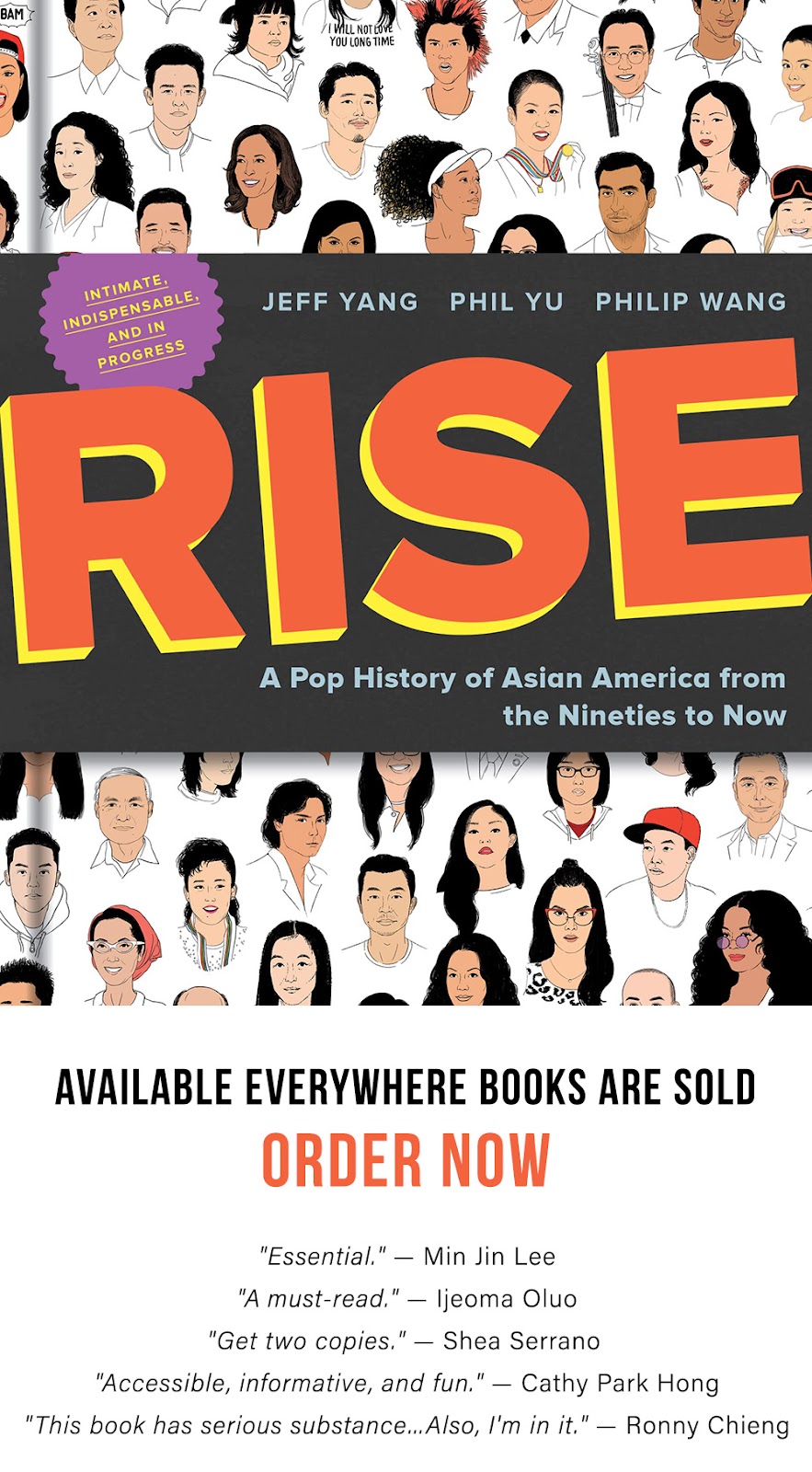
Guest Post by Jeff Yang

Welcome to May, folks — the month formerly known as Asian Pacific American Heritage Month.
And as this month begins, I've rarely been more puzzled and annoyed than I have been over the past few weeks, watching the bizarre backlash against Jin Chao, the small but pivotal part played by actress Helen J. Shen in The Devil Wears Prada 2.
Shen, best known for her mesmerizing lead turn in Broadway's robots-looking-for-love musical Maybe Happy Ending, is delightful in the role. The character herself is fun, witty and has a real and welcome story arc that ends with her boldly saving the day for Anne Hathaway's Andy and Meryl Streep's Miranda Priestley. She even gets a style glow-up, and is clearly positioned to play a bigger role in a third installment in the story, if there is one.
(Which is not unlikely: The movie banked $77 million at the North America box office and earned $233 million worldwide in its opening weekend, setting it up to match and maybe beat the original's blockbuster take.)
But you wouldn't know that from her 30 seconds of screen time in this promotional clip, which featured Jin meeting her new boss Andy for the first time. “If you don’t want me, you can interview someone else. That’s totally fine,” Jin says. “I did go to Yale, 3.86 GPA, lead soprano of the Whiffenpoofs, and my ACT score was 36 on the very first time."
Jin's brief nervous self-introduction was enough to send the Internet into a meltdown — even though very few people had seen the full movie (and certainly none of those who were engaged in discourse about the character online).
Launched by anonymous netizens based in China and then amplified by very online Asian Americans, the backlash initially attacked Jin's name, suggesting oddly that "Jin Chao" was somehow offensive — some claimed it sounded like "Cho Chang" (it doesn't) or "Ching Chong" (even less so, especially in Mandarin); others alleged that it sounded a little like the phrase for "very stinky" (quite a stretch).

Still others wondered why she didn't have a "normal American name" like Emma or Amy.

But it was easy to push back against the name Jin Chao, not least by pointing out that a search on any social media platform would point you to hundreds of actual people named Jin Chao — or Jin, or Chao, or other names that are close enough to it to give the lie to any suggestion that the name is weird or offensive. (For example, I personally know people named JIng Chao, John Chow, Jen Chao and uh, Jon Chu. None of their names sound like "Ching Chong," unless you happen to be very, very racist.)

If only that closed the door on this strange pile-on.
Instead, it merely opened a window for even more ludicrous attacks. People suggested that Jin Chao was ugly, short and fat. She was called an unstylish nerd, and the epitome of the "model minority" stereotype. The most unhinged commenters created AI images — some allegedly showing what the movie would look like if Andy were Asian — presented as a willowy K-pop star — and Jin — depicted with as grotesque a prompt as possible — were white. Some strangely chose to plunge into anti-Blackness, using horrifically bigoted images and language to suggest that Hollywood would never create a "racist character like Jin Chao" that was Black. (If you think that, you don't know Hollywood. Sit down.)


And then the movie hit theaters.
To their credit, some who were agitating for a boycott recanted after they saw the film. "I watched the movie and here's what I think," said one commenter. "Jin has an actual arc. Her styling gets chic, she shows real wit, and there are other Asian characters at the executive level. Watching the full film, there's no racist undertone at all."


But the commenter’s original post got hundreds of likes. Her followup? None.
All of this points to a new and uncomfortable reality for Asian Americans. We've sought meaningful representation for so long, and only recently have we started to see Hollywood respond, with stories and characters that depict us authentically and even aspirationally. Sadly, after COVID, when we experienced the direct (and often physical) impact of stereotypes, our community's vulnerability was exposed and our suspicions were sharpened. The return of a scathingly anti-immigrant administration further polarized our community, causing some to feel hunted, and turning others into cheerleaders for the hunters.
And these forces make us more susceptible than ever to misinformation and manipulation — to entertaining conspiracy theories, jumping to conclusions and responding without context.
Where the entertainment industry is concerned, it's somewhat understandable: We've been burned before so often that it's easy to flinch at the first sight of a potential spark. But knee-jerk reactions not only make us miss real opportunities to recognize and amplify work that deserves to be celebrated, they also give studios and networks an excuse to pull back on inclusion, in a climate where the powers in charge have told them DEI must die.
There's also the reality that our performers and storytellers have earned some faith and respect. Asian Americans in entertainment have become numerous and influential enough that they don't have to collaborate in stereotypical representation just to survive, and more and more are actively speaking out and pushing back on racist indignities on set, behind the cameras and out in public.
We have powerful allies, too. Ryan Coogler's work on Sinners organically wove Asian Americans into a Black Southern Gothic landscape. Bridgerton, Shonda Rhimes and Chris Van Dusen's wildly popular reinvention of Regency romance, has centered both South Asian and East Asian characters in its second and fourth seasons. Michael Schur put Jameela Jamil and Manny Jacinto in Hell along with Ted Danson, Kristen Bell and William Jackson Harper in The Good Place (2016-20), with brilliantly hilarious results, and Rachel Bloom made Asian dudebro Josh — played by Vince Rodriguez III — the object of her obsession in the cult comedy hit Crazy Ex-Girlfriend (2015-19).

Bloom's partner in creating Crazy Ex-Girlfriend was none other than Aline Brosh McKenna, who also happens to be the writer of the original Devil Wears Prada and its 20-years-later sequel. The first film featured zero Asian characters. McKenna’s sequel, reflecting two decades of growth in our community and our Hollywood representation, has three in critical roles: Lucy Liu as the philanthropist ex-wife of a philandering tech billionaire. Bridgerton’s Simone Ashley, as Miranda Priestley’s devastatingly composed new assistant (and real-time human-resources monitor). And, of course, Helen J. Shen as Jin Chao.
(Tony-nominated Conrad Ricamora was supposed to be in the cast as well, playing Andy’s roommate! Unfortunately, his role was cut in the final edit. And there are other visible Asian characters in background roles, including a fun pop-up cameo by none other than comedian Ronny Chieng.)
This is what progress actually looks like. Which is why it was so infuriating to me to see people making snap judgments on minimal information, while also making arguments that feel wildly out of sync with the priorities we have today as storytellers, creators, artists and audience members.
I remember when the only Asians we ever saw on TV and in film were gangsters, prostitutes, sidekicks, kung fu guys and buffoons. I was a loud voice in calling out the need for roles that put us in the spotlight, as hunks and heroes, as aspirational figures, when those were exceptionally rare. But every time I sat on a panel where my fellow speakers demanded that Hollywood stop creating “bespectacled Asian nerd” stereotypes, I froze a little, because I see that “stereotype” every time I look in the mirror.
A stereotype is only a stereotype when there’s no complexity, no story arc, no humanity behind the visual representation — just tropes, exaggeration and outright falsehoods, deployed for the amusement of people who don’t see that image in their own reflections. But to gauge whether a character is a stereotype, especially in an era that has seen the very real results of decades of hard work by Asian activists in the streets and advocates in the industry, you need to go deeper than the mere surface level — especially when what you’re reacting to is an out-of-context five-second snippet in a promotional trailer.
Going deeper is what critics do. But consumers can do it too, by not jumping on bandwagons without seeking out facts and context, by not responding to fragmentary early glimpses, by doing research, by being thoughtful. It takes time, effort and patience. It means not getting the dopamine hit that comes with going viral by being early, loud and wrong.
But we’re not going to bring our stories and characters to the next level without it. Because we have a foot in the door now in Hollywood, and the ears of the news media.
The problem is that these two industries are not naturally inclined to do the right thing: Hollywood is risk-averse and constantly seeking reasons to push that door closed again, while the news media has become wedded to outrage as a way to farm clicks. And sadly, the “early, loud and wrong” reactions of Asians and other historically marginalized groups are often pointed to as an excuse by entertainment gatekeepers to not take chances on inclusive casting (better to be attacked for showcasing sure-thing insiders — mostly white, mostly straight, mostly male — than to risk being attacked by underrepresented communities, while also failing to cater to the “middle-middles”).
So as tempting as it is to jump into the fray of discourse without information or context, we need to be a little more judicious. A little more generous. A little more thoughtful. It’s the burden every group fighting against privilege must bear: We have to work a little bit harder to get it right, because the penalties for getting it wrong are that much greater.
And in truth, for anyone putting in that effort, the clues were all there that Jin Chao wasn’t a stereotype; that there was much more to her than meets the eye, and that her role could even represent a turning point for the franchise.
Allow me to extrapolate from the very same five-second clip that sent the Internet into a flame spiral: “If you don’t want me, you can interview someone else. That’s totally fine,” Jin says. “I did go to Yale, 3.86 GPA, lead soprano of the Whiffenpoofs, and my ACT score was 36 on the very first time."
Yes, you could read this line, along with her quirky, nerdish appearance and obvious lack of self-esteem, as evidence of Yet Another Cartoon Asian Sidekick — a self-hating model-minority whiz kid without the drive or confidence to do anything but play second banana to the white lead.
Or you could look closer, and pick up the subtle but discernible traces of Jin Chao’s extremely relatable backstory.
Why is her name “Jin” and not “Charlotte” or “Amelia”? Well, it’s likely that she’s the child of recent first-generation immigrants. Which also explains why she excelled academically and got into an Ivy League school: Because what’s what her immigrant parents expected of her.
So she got good grades and solid SATs. But honestly, not good enough to get into Yale on the strength of her numbers alone. (I just went through the grueling gauntlet of college applications with my younger son, and we learned firsthand that 3.86 GPA and 1560 SATs is hardly “exceptional” — it’s the bare minimum for top schools now.)
But the very fact that she’s working for a magazine is a clue to what did get her into Yale. It was likely something that her immigrant parents thought was a waste of time (like mine did): Her creative pursuits… particularly her love of writing. I can’t guess what her college personal statement was, but it was probably exceptional. It had to be, to make her stand out among the tens of thousands of other people applying to one of the top five colleges in the nation.
And yet, as was the case for a lot of us, the very thing that ended up fulfilling her hard-working parents’ dreams also turned into the seed of their worst nightmare. Because while Jin’s love of writing and talent for it bagged her an Ivy degree, it also led her to take an entry-level assistant position in publishing, where she’s paid almost nothing and treated like crap.
(Source? Me. I went to an Ivy and then took a similar paid-almost-nothing-and-treated-like-crap job upon graduation. The disturbance in the Force from the other side of the phone line when I told my parents I’d be making $17K a year, with three times that in student loans on my shoulders, was as if a thousand generations of Yangs suddenly cried out in terror and were suddenly silenced.)
But there’s more revealed in Jin’s flash intro than just her status as an overqualified and underpaid white-collar media serf. You see, she also reveals that she’s the only assistant who wanted to work with Andy, who’s the new News Editor at Runway, overseeing a department that has bottom-rung status and priority at one of the most revered titles in media. Why would you possibly want to work for the — ugh! — news department at the world’s biggest fashion periodical?
Well, it makes sense, if you’re a quirky, nerdish child-of-immigrants who loves writing, something you were never praised for and had to cultivate in secret while toiling through “real classes” like bio and math, because your immigrant parents expect you to graduate and get a stable job that will pay the bills (and those student loans!) and bring honor to your family.
(Source? Me, again. Because this was me. THIS WAS ME. Except I’m a guy, and I went to Harvard.)
Despite those expectations, at some point, Jin had The Talk with her parents, telling them she didn’t want to go to med school or work on Wall Street, and that her passion was writing. And specifically, it was almost certainly writing about women’s issues, for a female audience.
How do we know this?
Well, she’s a Whiffenpoof. A member of Yale’s world famous a cappella singing group… that until 2018, was all male.
Which means quirky, nerdish Jin was likely one of the first women to break that boundary — a campus pioneer.
And undoubtedly when she got into the Whiffs as one of its first women, and maybe first woman of color, she did what she does best: She wrote about it. An op-ed or feature for the Yale Daily News. It got notice. Maybe it won an award.
And maybe it got her a job as an assistant at one of the most glamorous magazines in the world… even though she wasn’t an English major and had no experience or background in student journalism, just enthusiasm and undiscovered, unappreciated talent.
Talent which stayed unappreciated. Because even though Jin was finally working at one of the world’s biggest and most prestigious publications for women, what she wanted to do, write news and opinion for women, was considered lame and low-priority compared to the latest looks in Milan and the hot goss about this model or that celebrity.
And of course, her quirky, nerdish ways were looked down upon by the Mean Girls at the office, who can’t see past her granny glasses and low-fi Greenpoint thrift outfit, just like they have been by the Mean Girls of the internet.
Jin, who graduated from a top school, is likely loaded down with debt and probably isn’t talking to her parents, is stuck on her own and at the bottom of the food chain, with no obvious way up and out.
Until Andy comes along, that is.
Andy isn’t just a savior for her dreams of writing real stories for and about women. She’s everything Jin wishes she could be: An award-winning editor, stylish, confident, unworried about the Mean Girls and what they whisper, excelling in her career. But she wasn’t always like that. In fact, when Andy started out…she was a lot like Jin
Of course, Jin wouldn’t know that when she first meets her. So she blurts out her bio, looking like a total dork in front of her role model, then probably stayed up all night in her shared Brooklyn apartment silently screaming at herself for making such a dumb first impression.
Fortunately for Jin, it doesn’t matter. Andy takes her under her wing! Mentors her. Helps her change how she dresses and talks — helps her evolve the way Andy evolved herself, after she graduated from elite Northwestern University as a quirky, nerdish, overachieving girl…only to find herself working as an underpaid, under appreciated assistant for the Queen of Mean Girls herself, Miranda Priestley.
Given real support and opportunity for the first time, Jin blossoms (pun not intended)! We see this happen in the movie! And — without spoilers — she ends up saving the day of both Andy and Miranda through her own cleverness, while taking advantage of the very stereotype people have mistakenly projected onto her.
Because the truth is, nobody notices the quirky, nerdish nobody who’s been relegated to editorial exile. No one pays attention to the quiet Asian woman. That stereotype is like an invisibility cloak that lets her get away with…well, you’ll see.
The bottom line, though, is that Jin is a hero. And she’s clearly set up to be Andy 2.0, the next generation.
So for those who pay attention, she’s actually set up as the most interesting new character in the cast, and if there’s a third movie, poised to step into a major role. Maybe even one that sets her up for a spinoff.
But you have to go beyond a facile, knee-jerk reaction to what you think five seconds of a trailer tells you.
Haven’t Asian American creators and performers earned the right not to be judged by first impression? The lesson of Jin Chao should be that the answer to this is an unequivocal yes.
To be fully clear: None of the above is canon. It’s extrapolated from what we see and hear in the movie, not explicit in its exposition. But it is a part of the film’s narrative plenitude, which allows all of us, especially Asian Americans, to imagine ourselves in characters that finally and authentically reflect us and our experience — not just our fantastical aspirations.
Because I saw the movie early and yet was unable to provide spoilers as a result, as I said, watching the wild reaction from people seeing only the trailer and jumping to the wrong conclusions made me deeply upset for Helen J. Shen, and incredibly sad and angry for anyone who would watch the movie and see themselves in Jin — the quirky, nerdish secret writer who blooms when finally given the water of respect and opportunity.
Like me.
JIN IS ME.
* * *
I write this as May begins, but also as my close friend, collaborator and cohost Phil Yu celebrates the 25th Anniversary of this blog, a place where all of us have had the chance to see ourselves represented, and to complain and commune when we see ourselves misrepresented. A place where it’s safe for us to be angry, and to speak when it’s not “our turn.”
For two and a half decades, Phil and others who read this blog (and occasionally contribute to it) have fought to make change in the cultural and narrative landscape — to make all of society our safe space to speak up and when necessary, be angry.
I wrote the above for this blog now because as we enter into the next 25 years of Angry Asian Man, the values and ideals behind it — and behind the podcast Phil and I do, They Call Us Bruce — remain crucial and central to where our community is headed next. But how they’re applied constantly needs to change, and grow, and evolve, to meet the moment and the fresh challenges that it brings.
I’m proud of what Phil has done the past quarter century, and proud to be a part of it in a small way now. God willing, I’m looking forward to being a part of the next quarter century too.
Congratulations, dude. And 25th happy Angryversary!