Showing posts with label guest post. Show all posts

5.04.2026

Justice for Jin Chao: If Asian Americans Want Better Media Representation, We Need to Learn to Be Better Critics

Guest Post by Jeff Yang


Welcome to May, folks — the month formerly known as Asian Pacific American Heritage Month.

And as this month begins, I've rarely been more puzzled and annoyed than I have been over the past few weeks, watching the bizarre backlash against Jin Chao, the small but pivotal part played by actress Helen J. Shen in The Devil Wears Prada 2. 


Shen, best known for her mesmerizing lead turn in Broadway's robots-looking-for-love musical Maybe Happy Ending, is delightful in the role. The character herself is fun, witty and has a real and welcome story arc that ends with her boldly saving the day for Anne Hathaway's Andy and Meryl Streep's Miranda Priestley. She even gets a style glow-up, and is clearly positioned to play a bigger role in a third installment in the story, if there is one.


(Which is not unlikely: The movie banked $77 million at the North America box office and earned $233 million worldwide in its opening weekend, setting it up to match and maybe beat the original's blockbuster take.)


But you wouldn't know that from her 30 seconds of screen time in this promotional clip, which featured Jin meeting her new boss Andy for the first time. “If you don’t want me, you can interview someone else. That’s totally fine,” Jin says. “I did go to Yale, 3.86 GPA, lead soprano of the Whiffenpoofs, and my ACT score was 36 on the very first time."


Jin's brief nervous self-introduction was enough to send the Internet into a meltdown — even though very few people had seen the full movie (and certainly none of those who were engaged in discourse about the character online).


6.14.2022

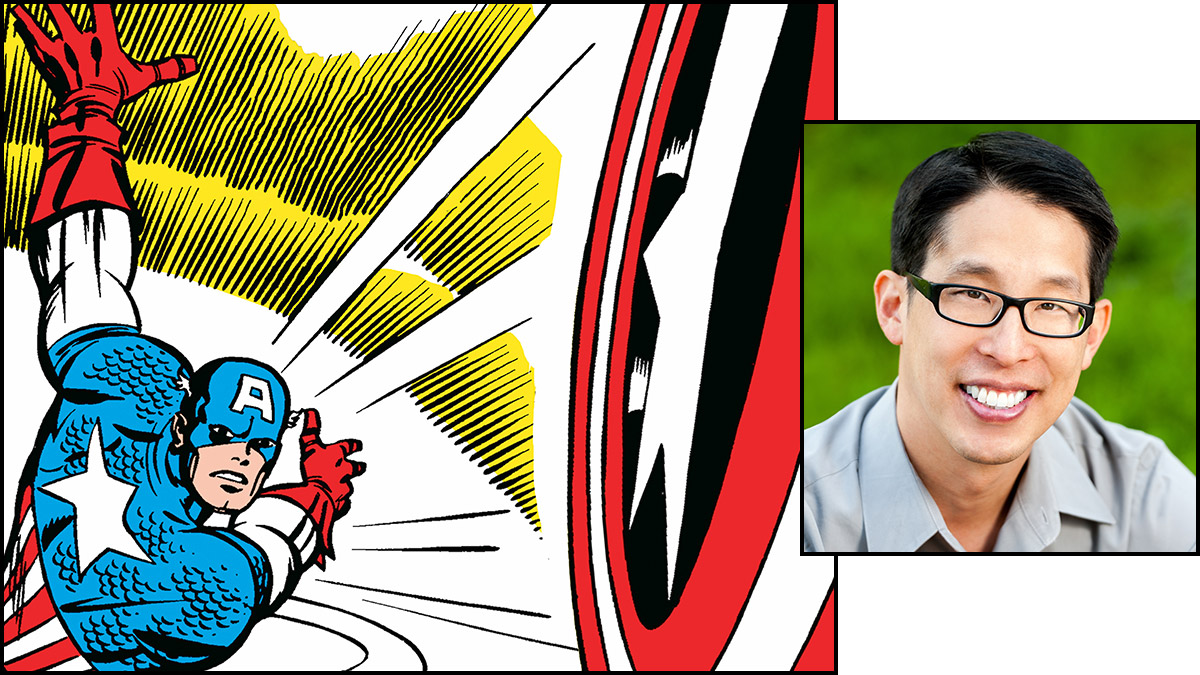
"An immigrants' kid punched Hitler in the mouth while cosplaying the American flag"

Gene Luen Yang on the corniness and coolness of Captain America -- the hero who is a flag on the move.


"The hero who dresses like the American flag. You can't get much cornier than that." As a young comic book reader, Gene Luen Yang didn't think much of Captain America. To be honest, he summarily dismissed Marvel Comics' star-spangled superhero as a dork -- and certainly nowhere near as cool as the X-Men.

But over time, Gene's relationship to Cap has evolved -- much like the flag, and America itself. In his foreword to the new Penguin Classics Marvel Collection edition of CAPTAIN AMERICA, the award-winning comic book creator shares about coming around to the appeal of Captain America's undeniable dorkiness, and his connection to Cap as a fellow child of immigrants. We're delighted to share Gene's foreword here:


3.30.2022

Silent River Speaks: Getting into the Present with Chris Chan Lee

Guest Post by Jacqueline (Jae) Kim


It's September 2021, year two of the Coronavirus pandemic -- and the world premiere of Silent River at Los Angeles Asian Pacific Film Festival (otherwise known as 'VC'). Among many of my friends, I haven't seen the director, Chris Chan Lee, in quite a while. After the film, I avoid the crowd and slip out but send Chris an email asking if he'd like to talk about his latest work via Zoom? I feel pretty sure the conversation will be something to document. Five months later, the film has been gaining critical momentum, earning its recent award at the Paris International Film Festival. Here's an excerpt:

Jae: Okay, so -- when I started getting involved with making my own films and eventually my own art projects, I started to see the processes and the results as self-diagnosis.

Chris Chan Lee: Mm.

Jae: How does that sit with you with regards to Silent River?

CCL: Well, you know, when I sit down to write, I never first think about the thematic content. I just think about, like telling the story, right? But I definitely notice a pattern with everything that I do that's not necessarily intentional: it's always about dealing with past and like regret and stuff like that. So that's always inherent in my work.

6.22.2021

The Monster Roars: On From Little Tokyo, With Love and Asian Girl Rage

Guest Post by Sarah Kuhn

I have always had an explosive temper. As a kid, it felt too big for my body—a monster that lived inside of me, pounding against the walls of my chest, screaming to be released into the wild. My anger burned fast and fierce and bright, and I quickly learned that the only way for a girl to handle that monster was to put it in a cage. Shove it down into the depths of your body until you can't hear it scream anymore.


Little girls aren't supposed to let that anger spill out of them, to draw others into their messy maelstrom of chaos. And, as societal stereotypes constantly remind us, little Asian girls aren't supposed to even feel that anger in the first place. We're supposed to be sweet and small and dutiful. We're supposed to offer ourselves up for the consumption of others.


We're not supposed to let the monster roar.


8.21.2020

Finding the Fire: On Community, Burnout, and That One Scene from 'Deep Space Nine'

Guest Post by Sarah Kuhn


There are certain scenes from stories that stay with us forever, their lines looping through our brains like the stickiest of earworms. I can recite sections of the '80s era Anne of Green Gables movies word for word. I know every beat, every breath, in the first Princess Leia/Han Solo kiss scene like the back of my hand. And occasionally, my mind tubes will just randomly call up the post-teaser scene from season 2, episode 2 of Star Trek: Deep Space Nine, "The Circle," and play it like it's my favorite song.

In this scene, tough-as-nails Major Kira Nerys (the iconic Nana Visitor) has been recalled to Bajor and is in the process of packing all her stuff. As she packs, she is constantly interrupted by her colleagues on the space station. They want to say goodbye, they want to give her gifts, they want to encourage her to challenge the reassignment and stay at her current post on the station.

"Fight for what you want!" shapeshifting security chief Odo growls at her. "It's what you do best."

As the door keeps chiming and more and more people pile into Kira's cramped quarters, the chaos builds to a perfectly calibrated pitch -- the dialogue snaps, the ensemble chemistry sizzles, and Kira's irritation grows from kindling to wildfire. Just as she's about to totally lose it and yell at all of them to get the hell out, yet another person enters, someone who's not a space station colleague -- hunky Bajoran religious leader Vedek Bareil. The hijinks bubble is pierced, the one-liners cease. Bareil apologizes for interrupting.

"No, please come in," Kira says hastily. "These are my..."

She pauses, the tension draining from her body. She looks around at all the faces who have intruded on her space, who won't shut up and go away. Her eyes soften, and a slight smile plays around the corners of her mouth.

"These are my friends."

This is a huge realization for Kira, a prickly freedom fighter with a hardscrabble past who never thought she would truly have friends -- or that she needed them. At that point, the beginning of season 2, DS9's varied, clashing ensemble of characters had fused into something she gave up on long ago: they are a family. A community. An assemblage of personages who will always show up for each other, even if it's in the form of totally irritating the friend they're trying to support.

I love this scene. It's like its own little story, its own little arc, each perfectly composed beat playing out to a satisfying conclusion. I love it so much, that I recently realized I've written a version of this type of scene in nearly every one of my books. My Heroine Complex books, in particular, always have this scene: the rag-tag crew of misfits that is my superheroine team have become their own kind of found family, and there's always some moment where they just have to pile into the protagonist's room and offer their own kind of chaos-packed support for whatever she's going through. The latest book, Haunted Heroine, actually starts with this scene, all of fire-wielding, pregnant superheroine Evie Tanaka's friends cramming themselves into a tiny bathroom to check on her after some unceremonious puking.

In a way, it is my favorite song.

2.26.2020

"All and None of Those Places"

A Conversation Between Fantasy Authors Fonda Lee and K.S. Villoso


Photo: Elena Rose Photography / Mikhail Villoso

In The Wolf of Oren-Yaro, the new debut epic fantasy novel from K.S. Villoso, a queen of a divided land must unite her people. Jade City and Jade War -- now out in paperback -- are the first two volumes of Fonda Lee's "Green Bone Saga," an epic trilogy about family, honor, and those who live and die by the ancient laws of blood and jade. The two authors recently chatted with one another about their respective narrative approaches, creating Asian-inspired fantasy worlds, and Asian representation in publishing.

2.19.2020

Letter To My Father

Guest Post by Rachel Pak


The Tahirih Justice Center is a national, nonprofit organization that serves immigrant women and girls seeking safety and justice. We amplify the voices of survivors in communities, courts, and Congress to create a world where women and girls enjoy equality and live in safety and with dignity.

Dear Dad,

I know this country was not always kind to you when you immigrated. Your parents brought you to America in the 1970s, seeking a better life from a developing South Korea. You entered a country that in the past has chosen to exclude Asian immigrants during moments of national panic, and then include at economically opportune times—from the 1882 Chinese Exclusion Act to the incarceration of close to 120,000 Japanese descendants during World War II.

With legislation passed in 1965 and a need for skilled laborers, migration from Asia reopened, allowing you and my grandparents to move to the U.S. In a country that did not fully welcome you, with policies that historically excluded you, you worked hard to provide my sister and me a better future in America. I am immensely grateful for your sacrifices -- however, I want us to pay attention to the current state of immigration policy in the U.S.

The racism in our laws hasn't gone away. It continues -- it is vicious and is targeting migrants arriving at our southern border. Even more tragic, our government’s policies are stripping away the right to simply seek safety from people who are fleeing for their lives. I saw this first-hand when I was at the border between El Paso and Ciudad Juárez last December.

11.08.2019

To Kurt Suzuki: About That Hat and "Having Some Fun"

Guest Post by Joseph Shoji Lachman


Kurt Suzuki, a yonsei (4th gen. Japanese American) wore one of those disgusting white supremacist hats when visiting the White House. It was horrifying, and symbolic of larger issues of Asian Americans and adjacency to white privilege.

The question I always want to pose to these garbage Japanese Americans is, how can you support a guy whose campaign and supporters have voiced support for the incarceration of Japanese Americans and have used it as a justification for oppressing other minority groups?

Suzuki couldn't even muster an apology. He said he was just trying to "have some fun." I wonder if he could go to a migrant concentration camp, look a mother and child in the eyes while wearing that hat, and claim it's just about having some fun.

I wonder if he could look me in the eye as a fellow yonsei and say it's just about having some fun.

5.30.2019

Making a Scene: How Claudia Kishi Helped Me and My YA Heroine Find Our Voices

Guest Post by Sarah Kuhn


I love Claudia Kishi. Ever since she first emerged on the pages of The Baby-Sitters Club books -- that touchstone series about enterprising tweens who start their own small business and become embroiled in the world of Kid Kits, cruises, and mysteries that involve things like ghost cats -- I've been obsessed with her every move. I related to her creativity, her inability to master math, and her whole Japanese American girl living in the white suburbs thing. I coveted her in-room phone line, her hollowed out books full of candy, and of course... her clothes.

Oh, her clothes. So many bright colors. So many "clashing" patterns. So many bedazzled ankle boots. The endless pages that lovingly describe her outfits (often characterized as "wild") are the most worn and dog-eared in my BSC collection. I wanted every single piece of her wardrobe so very badly.

But I also found myself caught in a classic tweenager-y paradox. I thought I wanted to stand out like Claudia, but I also knew in my heart of hearts that it would probably be better for my whole middle school experience if I did not stand out at all. At least, not any more than I already did, thanks to that "Japanese American girl living in the white suburbs" thing.

I sometimes found myself trying to incorporate a Claudia-esque piece into my look -- oversized men's shirts, scrunchy socks in a Technicolor rainbow of colors, barrettes shaped like animals. But I always ended up feeling self-conscious, the bravado I'd felt when clipping that sparkly giraffe into my hair melting as soon as one of the popular white girls sent me one of those disdainful looks that just seemed to say: really?

10.10.2018

The American Dream isn’t Colorblind. College Admissions Shouldn’t Be, Either.

Guest Post by Jang Lee


Edward Blum, the mastermind behind the Harvard lawsuit, appeals to the myth of American meritocracy to claim that race should not be used in the college admissions process; but he fails to acknowledge that the American Dream -- predicated on such meritocracy -- is not colorblind. In this nation, the color of our skin still shapes how we access opportunity and whether we profit from our labor.

8.17.2018

What was really happening in Crazy Rich Asians’ pivotal mahjong scene

Guest Post by Jeff Yang


One of the most beautiful things about Crazy Rich Asians is how it refuses to explain many of its most intrinsically Asian elements. That lack of training wheels is intentional: As director Jon M. Chu told me, "We didn't want to give people an excuse to think of this world as some kind of obscure, exotic fantasyland -- this is a real place, with real culture, history and tradition, and instead of just giving them answers to their questions, we want them to have conversations."

The movie's Singapore-specific local color and broadly Asian cultural nuances are indeed fairly Google-able, and can readily be contextualized through polite discussions with actual Asian people. But there's one scene in particular that has been resiliently enigmatic to audiences of many backgrounds, both Asian and non-Asian... and it's a pivotal one: The mahjong scene.

That's especially true for fans of the book, who won't recognize it -- it's original to the movie. It was inserted in part because Michelle Yeoh, who delivers an amazing steel-and-silk performance as the movie's main antagonist, refused to play the stock, villainous tiger mom from the book. This scene provides her with critical impetus toward her eventual redemption.

But it's also true for people who don't understand the complex rules of the game, which aren't intuitive and are often different depending on region of the world. So here's a quick primer on the game of mahjong itself, as well as its significance to the film in that pivotal scene. Spoilers abound starting here, so if you haven't yet watched the deliriously warm and funny movie, crawl out from under that rock and see it before reading further.

8.10.2018

#NeverAgainIsNow: Why the 30th anniversary of Japanese American Redress matters today

Guest Post by Tsuya Hohri Yee, Co-Chair New York Day of Remembrance Committee; and Joseph Shoji Lachman, Co-founder of Never Again.


Photo Credit: Densho/The Kinoshita Collection & The Rafu Shimpo

August 10th marks the 30th anniversary of the Civil Liberties Act of 1988, which granted a presidential apology and monetary reparations to living Japanese American families who had persevered through World War II incarceration for simply looking like the enemy. Over 120,000 people were removed from their homes and imprisoned in concentration camps in remote areas of the country. The majority were U.S. citizens and 1/3 were children. While no amount of money could ever undo the damage to Japanese American families and our democracy as a whole, the Act was a landmark piece of legislation, and represented decades of grassroots organizing across the country. Many Japanese Americans, young and old were inspired to join the Redress Movement by the work of Civil Rights Movement activists of the 1960s, and mobilized our communities to come together to fight for an apology and reparations. Allies in the Black and Latinx communities came to the aid of Japanese Americans, recognizing the commonalities of our struggles, and through this powerful coalition work Japanese Americans finally saw some semblance of justice for our families.

What the Redress movement achieved went beyond the Civil Liberties Act. Our community is not monolithic and there was significant debate about how to "right this wrong," including the view that demanding compensation would bring negative attention to our community. Others felt that creating a Commission to study the incarceration, including prisoner testimonies was demeaning and unnecessary. But those disagreements didn't stop us from moving forward and when it mattered most, we rallied our support around the Civil Liberties Act. Painful divides between individuals and groups who had chosen different paths during the war that had once seemed fixed in stone, now see the possibility of eroding. As part of the healing process the Redress movement started, annual Day of Remembrance programs were organized across the country giving communities an opportunity to reflect, learn, and join together in solidarity around our common history. Japanese Americans also began journeying back to camp sites on pilgrimages to reclaim the stories of their parents and grandparents and to begin piecing together what was lost. Today we look back with admiration at what we fought for and accomplished as a community.

7.31.2018

#KeepPJHome: ICE is targeting the Cambodian community for deportation... and this man might be on the top of its list.

Guest Post by Thi Bui.


Last week, I caught up with Borey Ai aka PJ, whom I wrote about in this piece for The Nib:

Refugee to Detainee: How the U.S. is Deporting Those Seeking a Safe Haven

It's been twelve weeks since PJ was released from ICE detention, two years since he was released from a life sentence in prison for a crime he committed at the age of fourteen. The #KeepPJHome campaign is going strong. Hundreds of postcards have been mailed to California Governor Jerry Brown, asking him to grant PJ a pardon in light of his rehabilitation and years of service to others as a counselor and advocate for juvenile justice reform.

We sat on a grassy knoll overlooking Oakland's Lake Merritt. PJ told me it's been a long time since he sat down in a park. We chatted about how you can rent kayaks and sailboats on the lake. He asked me if there were things I've always wanted to do since I was a kid, and I replied that I've been using my adulthood to catch up on them. I asked, "What about you?"

"So many things," he answered with a smile that looked mostly optimistic but which I couldn't help thinking was incredibly sad at the same time. I thought about a life, humans in cages, and how Americans don't feel safe even though the US has the highest rate of incarceration in the world. Meanwhile, PJ played with a small dog that came to lie down in his shadow and chatted with her owner, an elderly woman with a walker.

A short while later, an electronic beep told him it was time to change the battery on his ankle monitor. He put a fresh battery into the bulky plastic contraption under his sock as we discussed the process of getting a 47-hour pass from his parole officer to go to Stockton to visit his mother and see his childhood haunts.

All of these lingering effects of imprisonment go away if PJ receives a pardon.

7.11.2018

Going On the Heroine’s Journey and Finding Hope in the Dark

Guest Post by Sarah Kuhn


Heroine's Journey, the third book in my series starring Asian American superheroines, came out last week. It's the end of a trilogy -- but also the launch point for a new one because I just signed on to continue the series with three new books and a novella! I could not be more thrilled and I still can't believe I get to write more adventures, romance, and ridiculous battles against things like demonic cupcakes for these girls.

But there was a moment when I definitely, absolutely, one hundred percent thought I would never finish Heroine's Journey. Like, ever.

The issue was, shall we say, multi-fold. First, since becoming a "professional" "author," I have more demands on my time, more deadlines to stay on top of, and more reasons to procrastinate on Twitter. Second, I chose personally difficult subject matter. Heroine's Journey belongs to Bea Tanaka, little sister of Evie Tanaka, the fire-wielding protagonist of the first book. Bea is impulsive, tempestuous, and bad at sharing food. She has a power that's akin to mind control and a moral compass that could easily turn supervillain when things go bananas. She's also still grieving the death of her mother a decade earlier, and her conviction that this loss has messed her up for the rest of her life is a big part of what she has to deal with in the book. I lost my own mother to cancer right after I graduated from college, and all these years later, the topic still feels delicate to write about, talk about, or even bring up. I never thought I'd put it in a book -- but that's where the book, and Bea, wanted to go.

And third, of course, is the general state of the world these days, which feels like an endless stream of trash fires raining down upon us, our basic human rights, and any social and political progress we've made the last few decades. I don't know a single writer who hasn't been affected by this, who hasn't struggled to get words on the page since the current administration took power.

6.06.2018

Searching for Queer Asian Pacific America

Guest Post by Patrick G. Lee


I grew up thinking that you could be queer or Asian, but never both. That definitely had to do with the TV shows I watched (Will & Grace; Sex and the City) and the people I met at my Korean church (all straight or super super super closeted).

So when I started coming out as a queer Asian person in my twenties, I just assumed that I was on my own. Almost all of my gay friends from college were white, they all spoke the same language as their parents, and they had long ago dealt with the coming out process.

But a few years later, I moved to New York and made my first gay Asian friends in the city. We all met at a family acceptance workshop for Asian Pacific Islanders at the LGBT Center in Manhattan. That summer, we danced together, sang karaoke together, and ate Korean BBQ together -- and our chosen family just kept growing.

Many of us shared anxieties over communicating with our immigrant parents and coming out to our families. Visiting relatives abroad meant re-entering the closet. But we had each other to commiserate and confide in.

At the same time, I felt lost and unmoored in my personal history as a queer Asian American: I had found my chosen family, but who were our parents and our grandparents, our aunties and our ancestors?

2.16.2018

Another Parade: The Olympics and LGBTQ Asians and Pacific Islanders

Guest Post by Glenn D. Magpantay, Executive Director of the National Queer Asian Pacific Islander Alliance


Sports was never my thing. In high school gym class, I would always be the last person to be picked for a team. No one wanted me. I was too fat. Too slow. And I was uncomfortable in my body. The jocks called me queer for being effeminate.

But, today, I’m captivated by the Winter Olympic Games in PyeongChang. They show us how we can be all of who we are—that we can live our lives authentically and achieve our fullest potential in whatever we do. They also remind me that the world is still a dangerous place to be LGBTQ.

1.09.2018

5 Lessons From Hot Asian Men For 2018

Guest Post by Ada Tseng, Professor of Hotness


(Clockwise from top left) Saagar Shaikh, Mike Bow, D'Lo, Sean Miura, Yoshi Sudarso, Jake Choi, Peter Sudarso, Chris Pang, Simu Liu, and Ilram Choi. Photo by Sthanlee B. Mirador/Sipa USA.

First, we exchanged Haikus With Hotties. Then we put Haikus On Hotties. It's our third year making hot Asian man calendars to celebrate our favorite talented creative Asian men in the media, and this year, fans wrote Haikus For Hotties, and each spread is designed into a magazine cover, as a nod to the fact that Asian American men (and women, for that matter) are now sometimes featured inside the magazine, but still rarely on the cover.

9.15.2017

Breaking Stereotypes When It Matters Most

Heroes from Houston's restaurant industry step up during Hurricane Harvey. Guest Post by Thomas Nguyen.


Hurricane Harvey made landfall in Texas on August 25, 2017, and is likely to be the costliest natural disaster in U.S. history. Harvey dumped more than 50 inches of rainfall in Houston, Texas, causing catastrophic flooding and damage to over 200,000 homes and businesses.

With over 12,000 restaurants that include everything from Ethiopian, Pakistani, barbeque, Viet-Cajun, Tex-Mex, to South African, Houston has unofficially become the most diverse city in America. But what makes Houston unique isn't just the diversity of cultures and people, it is seeing everyone come together in times of tragedy, catastrophe and chaos. Among the overwhelming number of inspirational and heroic stories during Harvey these past few weeks were chefs, owners and volunteers from Houston's burgeoning restaurant industry.

A handful of these stories involving Asian Americans stood out to me. Not because they were more significant than any others, but because they demonstrated traits that went against typical Asian American stereotypes. These individuals were not weak, silent or passive. They were leaders, they were compassionate, and they wholeheartedly contributed to those who needed help.

9.11.2017

Autopsy: Tommy Le Shot Twice in Back by Police for Holding a Pen | #JusticeforTommyLe

By Jenn Fang. Cross-Posted from Reappropriate.


On June 14th, twenty-year-old Tommy Le was shot and killed just outside of Seattle, Washington by King County Sheriff’s deputy Cesar Molina. After the shooting, Molina insisted that Le was shot for approaching police aggressively while wielding an object that appeared to be a knife, and that Le further refused to comply with officer orders to drop the weapon.

That version of events is now in serious doubt after an investigation revealed that Le was actually holding a pen, not a knife, when he was shot and killed; and now, an autopsy of Le’s body further shows that Le was actually shot twice in the back, and a third time in the back of the hand. Those findings are incompatible with Molina’s insistence that Le was approaching police when he was killed.

Finally, toxicology reports show that Le was not under the influence of any drugs or alcohol. Although it remains possible that Le was suffering a mental health crisis at the time of his killing, Le’s family say that he had no history of mental illness.

8.09.2017

Have we made it to the top?

Guest Post by Jessica Jinn, Asian Americans Advancing Justice - Los Angeles


The author at her college graduation with her very pleased parents.

My parents cried when I did not get into UC Berkeley. My dad literally held the denial letter in his hands and cried. I cried, too. All my life I had been told to go to Berkeley and suddenly, I wasn't allowed. What was worse was that one of my best friends, a Latina, had gotten accepted. Despite the fact that California banned its universities to consider race in admissions at that time due to Proposition 209, life as an 18-year-old was horrible and we didn't know what else to do but blame affirmative action.

As affirmative action comes into the national spotlight again, one thought comes to mind: not this again. I knew Asian Americans would be pulled into this debate and depicted as affirmative action haters. With a story like mine, I would have been a prime suspect to oppose affirmative action. I am the Asian American that Edward Blum is hoping to take advantage of.

angry archive